California Civil Code Section 1941.1 mandates that multi-family rental dwellings remain free from rodents, vermin, and biological vectors. In dense rental corridors such as Koreatown, Silver Lake, and Echo Park,…
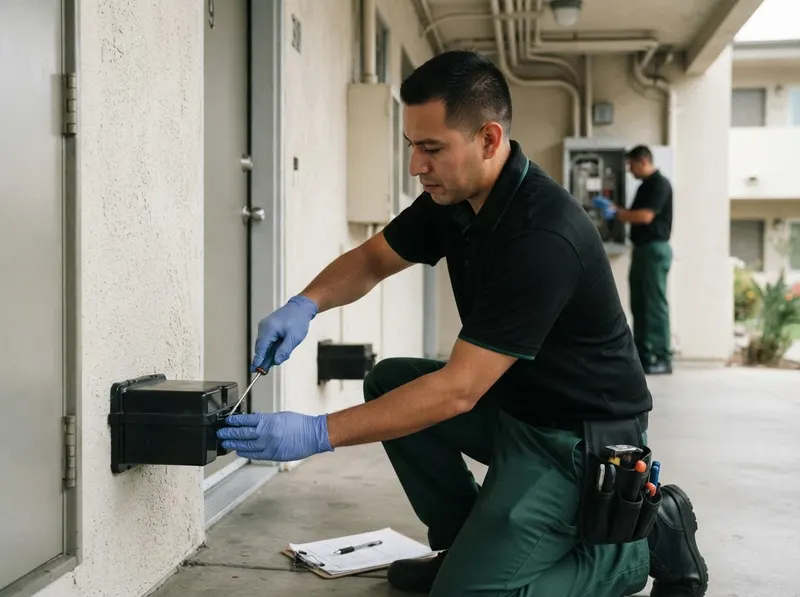
California Civil Code Section 1941.1 mandates that multi-family rental dwellings remain free from rodents, vermin, and biological vectors. In dense rental corridors such as Koreatown, Silver Lake, and Echo Park, structural multi-unit housing frequently shares plumbing wet walls, sub-slab utility tunnels, and continuous attics. When an infestation occurs in one residence, pests migrate rapidly through common vertical chases. Multi-family commercial pest compliance management operates by isolating these migration pathways using mechanical exclusion rather than indiscriminate broadcast spraying. Targeted micro-encapsulated baits and non-volatile gel matrices eliminate pests within wall voids without displacing volatile organic compounds into occupied tenant areas, maintaining a clean perimeter safe for family pets and children.
Los Angeles apartment inventory presents divergent vector pressures based on architectural era. Mid-century dingbat structures in Sherman Oaks and Encino feature open ground-level parking beneath residential units, exposing unsealed sub-floor plumbing conduits to roof rats descending from mature trees. Conversely, turn-of-the-century multi-family brick and lath-and-plaster properties in Boyle Heights and Highland Park contain extensive foundation fissures and uncapped crawlspaces susceptible to urban rodent populations. In coastal and hillside pockets like Venice and Brentwood, subterranean utility entries and lush exterior landscaping demand discrete copper mesh exclusion and structural flashing rather than chemical perimeter saturation.
Operational compliance requires precise physical interventions to prevent recurring city housing complaints. 1. Technicians conduct unit-by-unit exterior and interior threshold monitoring to map exact vector entry portals. 2. Staff seal mechanical penetrations larger than one-quarter inch using 16-gauge stainless steel mesh, silicone-blend elastomeric sealants, and metal escutcheon plates around shared pipes. 3. Low-impact botanical or inorganic dust formulations, such as amorphous silica gel, are placed inside dry plumbing voids to halt insect migration without producing airborne residues. 4. Detailed compliance logs, digital unit-by-unit tracking sheets, and treatment verification records are supplied to property managers for municipal housing audits.
Choosing full commercial compliance management over single-unit ad-hoc treatments involves an operational trade-off. Treating a single reported apartment provides temporary localized relief, but untreated adjacent units act as structural reservoirs, causing the infestation to re-emerge within 30 to 60 days. Comprehensive multi-family compliance requires coordinating access across multiple residences and incurs a higher upfront initial remediation cost, but it halts structural cross-contamination and shields housing providers from recurring administrative citations under Los Angeles Municipal Code Section 161.401.
Every job gets a firm, written price after a free on-site visit.
Tell us about your multi-family commercial pest compliance management job in Los Angeles and we'll send a clear, written quote, usually the same day.
 PestGuardian Plus